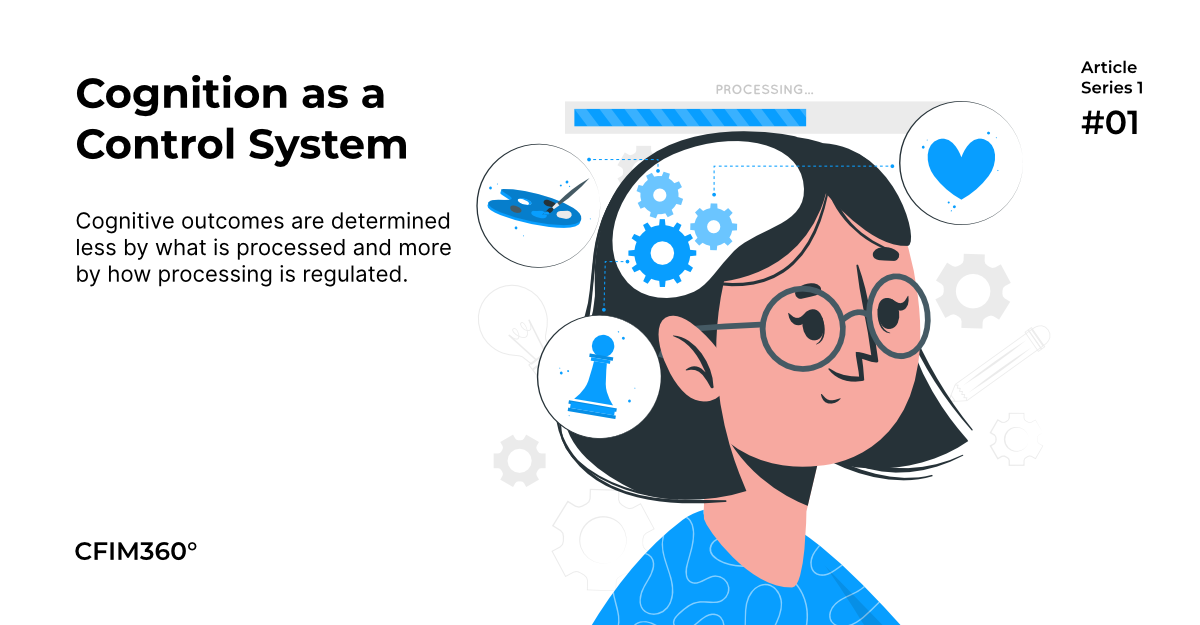
Cognition as a Control System
1. Framing the Problem
Most descriptions of cognition focus on content: beliefs, thoughts, representations, or conclusions. Cognitive Cybernetics begins elsewhere.
This article defines cognition as a control system: a regulated process that governs how inference moves, stabilizes, terminates, or reconfigures over time.
The central claim is structural:
Cognitive outcomes are determined less by what is processed and more by how processing is regulated.
This framing allows cognition to be analyzed independently of intelligence, correctness, emotion, motivation, or domain expertise.
2. Control vs Content
In a control-theoretic view, cognition separates into two layers:
- Content Layer Symbols, concepts, data, beliefs, representations.
- Control Layer
Mechanisms that regulate:
- when inference starts
- how long it continues
- which pathways are reinforced
- when evaluation stops
- when closure is triggered
Failures commonly attributed to “bad reasoning” often originate in the control layer, not the content layer.
A system can process high-quality content while operating under degraded control regulation.
3. Cognition as a Dynamic System
Cognition is not a static computation. It is a time-extended process governed by regulation.
Key properties:
- Cognition unfolds through state transitions
- Each transition is constrained by control signals
- Control signals persist across iterations
- Outcomes are path-dependent
This means cognition cannot be fully explained by inspecting isolated decisions or conclusions. The trajectory matters more than any single state.
4. Control Functions in Cognition
At a structural level, cognitive control performs four primary functions:
4.1 Initiation
Determines when inference begins and what qualifies as a valid entry point.
4.2 Navigation
Regulates movement through inference space:
- branching
- recursion
- hypothesis expansion
- comparison depth
4.3 Evaluation
Determines how signals are weighted, compared, or suppressed during processing.
4.4 Termination
Controls closure:
- when reasoning stops
- what counts as “resolved”
- whether ambiguity is tolerated or eliminated
These functions operate continuously, often implicitly, and shape cognition regardless of content quality.
5. Feedback and Regulation
Cognitive control systems are feedback-driven. Each inference cycle produces signals that feed back into the control layer, adjusting:
- future thresholds
- recursion limits
- evaluation sensitivity
- closure tolerance
Over time, feedback stabilizes the system into preferred operating regimes.
This stabilization is not necessarily optimal. It is structurally efficient under prevailing constraints.
6. Stability Without Correctness
A critical implication of the control-system framing: Cognitive stability does not imply cognitive correctness.
A system can:
- remain internally consistent
- produce fluent outputs
- respond rapidly
- appear coherent
while operating within a constrained or degraded control regime.
Stability indicates regulation, not validity.
7. Why Intelligence Is Not Protective
Higher intelligence increases content capacity, not control immunity.
If control regulation:
- enforces early closure
- suppresses recursion
- narrows evaluation bandwidth
- prioritizes termination over resolution
then intelligence accelerates convergence within a constrained space rather than preventing it.
This explains why highly capable systems can exhibit rigid or repetitive cognition.
8. Control Failure Without Error Signals
Control degradation often precedes visible failure.
Common characteristics:
- Outputs remain acceptable
- Performance metrics do not immediately drop
- No explicit contradiction appears
- The system “functions”
The failure exists at the regulatory level, where:
- degrees of freedom shrink
- alternative pathways are suppressed
- reconfiguration becomes difficult
By the time content errors appear, control failure is already entrenched.
9. Implications of the Control Perspective
Viewing cognition as a control system enables:
- Diagnosis without attributing bias, intent, or emotion
- Substrate-independent analysis (human, machine, hybrid)
- Explanation of persistent failure modes without invoking ignorance
- Separation of performance from autonomy
This perspective does not replace traditional cognitive models. It operates at a different layer.
10. Boundary Conditions
This article establishes only the structural framing.
It does not:
- propose corrective strategies
- evaluate desirability
- assign responsibility
- introduce emotional or motivational variables
Those belong to other domains.
11. Closing Statement
Cognition, at its core, is not a sequence of thoughts. It is a regulated system governing how inference moves through time.
Understanding cognition requires analyzing the control structures that shape its motion, not just the content it produces.
This control-system framing is the foundation upon which Cognitive Cybernetics is built.