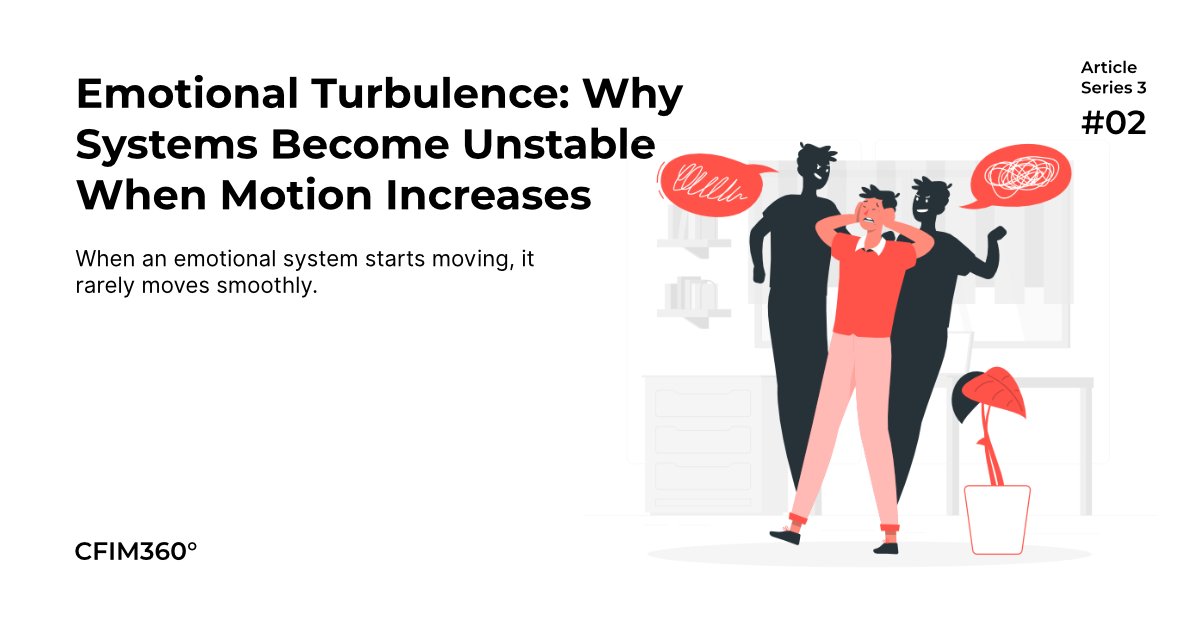
Emotional Turbulence: Why Systems Become Unstable When Motion Increases
When an emotional system starts moving, it rarely moves smoothly.
It shakes.
This shaking — the instability, the fluctuation, the sudden internal noise — is not emotional weakness. It is emotional turbulence, the natural consequence of a system trying to move faster than its internal forces can stabilize.
Most people interpret turbulence personally. In Emotional Cybernetics, it is purely mechanical.
Here’s how emotional turbulence actually works.
1. Turbulence Begins When Acceleration Outpaces Stability
At low speed, the system feels calm. Once acceleration increases:
- emotional signals amplify
- interpretations shorten
- reactions sharpen
- inner noise rises
- small triggers feel larger
This is not the emotion “getting worse.” It is the system struggling to stabilize new motion.
Turbulence is the mismatch between speed and stability.
2. Internal Forces Become Uneven When Motion Starts
When a system moves:
- some emotions accelerate quickly
- others lag
- some patterns activate instantly
- others stay dormant
This uneven activation creates internal conflict.
You feel pulled in multiple directions simultaneously.
That conflict is turbulence.
3. Interpretation Becomes Less Accurate Under Turbulence
As internal forces collide:
- perception narrows
- thinking speeds up
- details blur
- signals distort
The system starts reading the world through turbulence, not clarity.
This is why:
- neutral events feel charged
- small issues feel large
- timing feels off
- decisions feel rushed
The system isn’t wrong — it’s destabilized.
4. Emotional Noise Rises Faster Than Emotional Insight
Insight requires:
- space
- clarity
- low internal noise
Turbulence produces:
- rapid fluctuations
- emotional spikes
- unstable focus
- oscillating interpretation
Insight can’t form because noise replaces signal.
This is why people say:
“I can’t think clearly right now.”
They’re experiencing turbulence, not a lack of intelligence.
5. The System Starts Using Old Patterns as Emergency Stabilizers
When motion destabilizes the system:
- outdated reactions return
- old narratives reactivate
- survival patterns take over
- familiar coping strategies appear
This is not regression. It is emergency stabilization.
The system defaults to whatever requires the least processing. Turbulence forces the system to reach backward because reaching forward requires more clarity than it currently has.
6. Emotional Turbulence Consumes Energy Rapidly
Turbulence increases:
- emotional expenditure
- cognitive load
- physical tension
- interpretive effort
You get tired faster — not because you lack endurance, but because turbulence burns energy.
It is an energy-expensive state.
7. Turbulence Peaks Right Before the System Adapts
The moment turbulence feels strongest is often the moment before adaptation:
- the system is recalibrating
- internal forces are rebalancing
- clarity is about to return
- load is about to stabilize
Turbulence spikes before transition, not after.
Many people quit at the exact moment their system was about to stabilize.
8. Emotional Turbulence Is a Function of Motion, Not Identity
This is crucial. Turbulence does not mean:
- you are unstable
- you are weak
- you are inconsistent
- you lack discipline
- you lack clarity
It means:
The system is processing acceleration.
Turbulence is mechanical, not personal.
Summary
Emotional turbulence is what happens when a system begins moving faster than its internal architecture can stabilize. It includes:
- acceleration-induced instability
- uneven internal forces
- distorted interpretation
- high emotional noise
- fallback to old patterns
- rapid energy expenditure
- pre-adaptation intensity
Turbulence is not a flaw. It is the first sign that the system is entering dynamic motion.
Next in Series 3: How emotional systems stabilize turbulence while still moving — the mechanics of real-time emotional correction.