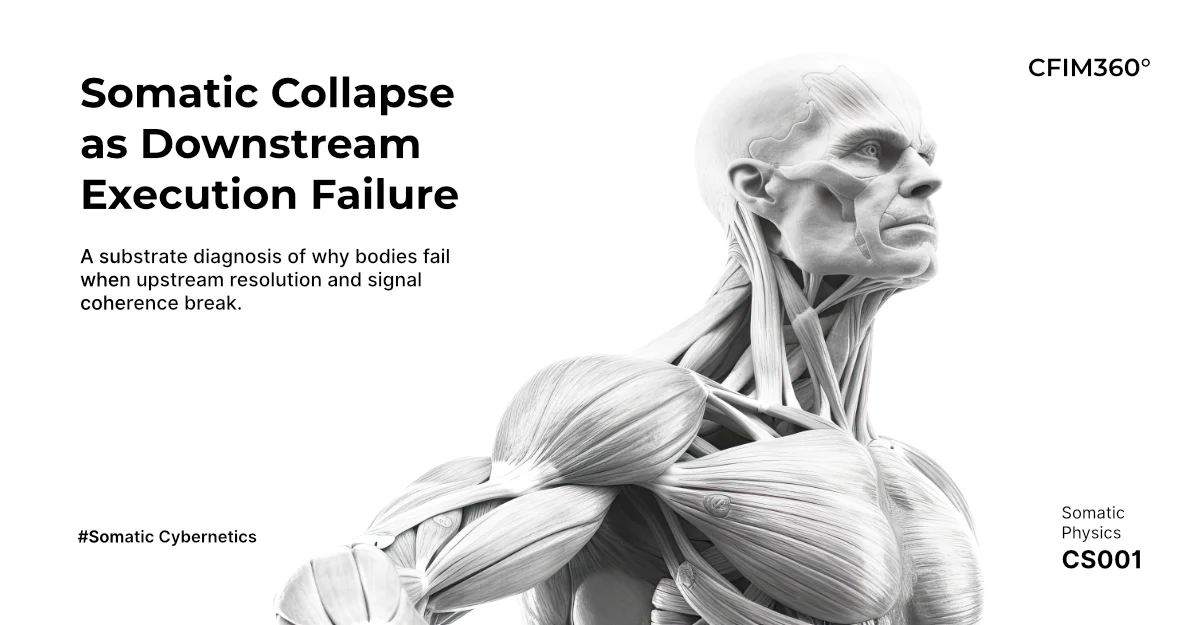
CS001 - Somatic Collapse as Downstream Execution Failure
A substrate diagnosis of why bodies fail when upstream resolution and signal coherence break.
Somatic Physics in Real Conditions
This document records somatic physics as it manifested under real-world conditions. It does not explain methods, provide instruction, or offer interpretation. All observations are preserved as recorded.
Executive Summary
This case study documents a deterministic failure pattern in how somatic behavior is interpreted within human systems.
It demonstrates that somatic collapse does not originate at the bodily level, but emerges as a downstream execution failure caused by unresolved emotional resolution states and incoherent cognitive signaling.
By analyzing somatic behavior as an execution layer rather than a causal origin, the study exposes why symptom suppression, linear intervention, and domain-separated models consistently fail to resolve chronic instability.
The work establishes directional substrate ordering, identifies compensation as a masking mechanism, explains symptom migration as load redistribution, and clarifies why the body becomes the primary blame surface despite not holding execution authority.
This case study completes the tri-substrate diagnostic sequence within CFIM360° and provides the substrate evidence required for formal Somatic Physics, without introducing prescriptions or governing equations.
Table of Contents
1. Orientation
2. Why the Biopsychosocial Model Fails Structurally
3. Directional Substrate Ordering and Execution Authority
4. Execution vs. Resolution
5. Compensation Dynamics and Stable Degraded States
6. Symptom Migration and Load Redistribution
7. Why the Soma Becomes the Blame Surface
8. Boundary Enforcement and Misinterpretation Limits
9. Structural Closure: What This Classification Enables and Forbids
10. Author & System Anchor
Pulse 0 — Orientation
0.1 Purpose of This Case Study
This case study isolates somatic behavior as an execution layer within a coupled tri-substrate system.
The objective is not to explain health, illness, or recovery. The objective is to expose where somatic failure actually originates when observed under deterministic load.
This document records what the soma does, not what it should do.
0.2 Scope Boundary
This case study analyzes:
- execution integrity
- load absorption
- compensation behavior
- failure stabilization
- symptom migration
It does not analyze:
- disease categories
- treatment efficacy
- psychological interpretation
- behavioral compliance
- wellness optimization
Any such reading constitutes misclassification.
0.3 Structural Positioning
Within CFIM360°, this case study occupies the Somatic Physics entry layer.
Somatic Physics is treated here as:
- execution under constraint
- signal discharge behavior
- failure absorption surface
The soma is not:
- a decision-making agent
- a resolution engine
- an interpretive system
It executes what upstream layers impose.
0.4 Directional Substrate Ordering (Declared)
All observations in this case study assume the following directional causality, which is not debated further in this document:
Emotional Resolution State
↓
Cognitive Signal Coherence
↓
Somatic Execution Integrity
This ordering governs:
- load transfer
- failure localization
- compensation limits
- stabilization outcomes
Reversing this order invalidates the analysis.
0.5 Why Somatic Failures Are Misattributed
Somatic behavior is:
- visible
- measurable
- local
- observable under instrumentation
Upstream dynamics are:
- invisible
- delayed
- distributed
- resolution-dependent
This asymmetry causes systematic misattribution of failure to the soma. This case study documents the consequences of that misattribution.
0.6 Method of Observation
The observations presented here are derived from:
- sustained tri-substrate interaction
- longitudinal load exposure
- repeated compensation cycles
- execution breakdown under stable upstream instability
No hypothetical modeling is used. No extrapolation beyond observed behavior is introduced.
0.7 What This Case Study Will Not Do
- It will not recommend interventions.
- It will not propose corrective strategies.
- It will not rank treatment paradigms.
- It will not assign fault.
It will only expose invariant structure.
0.8 Reading Orientation
This case study should be read as:
- a failure map
- not a care guide
- not a diagnostic manual
- not a health framework
Its value lies in reclassification, not resolution.
Pulse 1 — Why the Biopsychosocial Model Fails Structurally
1.1 What the Biopsychosocial Model Assumes
The Biopsychosocial (BPS) model assumes that human functioning can be understood by separating influences into three domains:
- biological
- psychological
- social
Each domain is treated as an independent causal bucket whose effects can be identified, isolated, and corrected through targeted intervention.
This assumption is additive and linear.
1.2 Structural Limitation of the BPS Assumption
The BPS model does not define:
- causal direction
- load transfer rules
- failure propagation
- compensation behavior
- stabilization under persistent mismatch
Without these, domains cannot be treated as separable. In practice, the model observes correlation while assuming causation.
1.3 Bucketization Error
By separating biology, psychology, and social context into parallel factors, BPS introduces a bucketization error.
This error manifests as:
- treating symptoms as local failures
- assigning interventions by domain, not by load origin
- assuming partial fixes accumulate into resolution
In a coupled system, partial fixes re-route load rather than remove it.
1.4 Absence of Directional Causality
The BPS model does not specify which domain governs:
- initiation of instability
- persistence of failure
- execution collapse
- recovery threshold
As a result, interventions occur at the most visible layer, not the governing one.
Visibility replaces causality.
1.5 Linear Repair in a Recursive System
BPS interventions are linear:
- treat the body
- address the mind
- modify the environment
However, the human system operates recursively:
- unresolved states feed forward
- compensation feeds back
- execution absorbs excess load
Linear repair applied to a recursive system increases internal tension.
1.6 Why BPS Appears to Work Temporarily
BPS succeeds in short windows because:
- somatic damping reduces visible distress
- cognitive reframing lowers immediate conflict
- environmental modification reduces exposure
These effects stabilize outputs, not origins. Temporary relief is mistaken for resolution.
1.7 Structural Consequence of Misclassification
When upstream instability persists:
- biological relief increases cognitive load
- cognitive insight increases emotional torque
- social accommodation delays resolution
The system compensates until execution fails. Failure is delayed, not prevented.
1.8 Why BPS Cannot Self-Correct
The BPS model lacks a mechanism to detect:
- misattributed causality
- upstream persistence
- recursive amplification
- stabilization in degraded states
Without directional invariants, the model cannot detect its own failure.
1.9 Transition Point
This case study does not reject the observations of BPS. It rejects the structural interpretation.
To proceed, the system must be analyzed as coupled gears, not parallel buckets. The next Pulse establishes that coupling explicitly.
Pulse 2 — Directional Substrate Ordering and Execution Authority
2.1 The Core Ordering Constraint
All observations in this case study obey a directional ordering constraint.
This ordering is not inferred. It is observed through repeated failure patterns.
Emotional Resolution State
↓
Cognitive Signal Coherence
↓
Somatic Execution Integrity
This direction defines authority, not influence.
2.2 Authority vs Influence
In a coupled system:
- Authority determines what must execute.
- Influence determines how execution is shaped.
The soma is influenced by cognition and emotion, but it does not hold authority over them.
Execution follows command, not preference.
2.3 What “Execution Authority” Means
Execution authority defines:
- where commands originate
- where load accumulates
- where failure localizes
The somatic layer:
- receives commands
- absorbs excess load
- manifests breakdown
It does not initiate instability.
2.4 Why Somatic Interventions Misfire
When intervention targets the soma:
- execution is damped
- output appears stabilized
- upstream load remains unchanged
Because authority is upstream, the command stream persists.
The soma compensates until capacity is exceeded.
2.5 Load Transfer Mechanics
Unresolved emotional states generate persistent torque. Incoherent cognitive signaling converts torque into erratic command patterns.
The soma absorbs this as:
- tension
- fatigue
- inflammation
- shutdown
- hypersensitivity
These are execution responses, not defects.
2.6 Failure Localization Error
Because somatic effects are:
- measurable
- observable
- time-proximal
They are misclassified as failure origin points. This produces the illusion that the body is “breaking on its own.”
2.7 Why Direction Cannot Be Reversed
Attempts to reverse causality by:
- forcing behavioral change
- suppressing symptoms
- optimizing performance
fail because execution layers cannot override command authority.
The soma cannot resolve what it did not initiate.
2.8 Deterministic Consequence
When execution authority is misunderstood:
- relief accelerates collapse
- compensation becomes pathology
- stability degrades silently
These outcomes are not incidental. They are deterministic under misordered intervention.
2.9 Structural Closure
Any model that does not respect directional authority:
- will misdiagnose failure
- will over-treat execution
- will under-resolve origin
This closes the ordering constraint.
The next Pulse isolates execution vs resolution, which is where most confusion arises.
Pulse 3 — Execution vs. Resolution
3.1 Defining the Distinction
Within a tri-substrate system, execution and resolution are not interchangeable functions.
- Resolution closes a state.
- Execution carries a state forward.
The soma executes. It does not resolve.
3.2 What Resolution Actually Means
Resolution is the termination of an internal conflict or load condition such that:
- command persistence stops,
- signal volatility collapses,
- no further compensation is required downstream.
Resolution is upstream by necessity. Execution layers cannot terminate commands.
3.3 Why Execution Is Mistaken for Resolution
Execution produces visible change:
- reduced pain,
- improved function,
- restored activity,
- measurable physiological shifts.
These changes mimic resolution but lack closure. The absence of immediate distress is misread as completion.
3.4 The Resolution Gap
When execution improves without resolution:
- upstream load continues,
- command pressure accumulates,
- execution must scale compensation.
This gap widens silently until capacity is exceeded.
3.5 Compensation as Pseudo-Resolution
Compensation allows execution to continue under unresolved load.
It appears as:
- endurance
- adaptation
- resilience
- “coping”
Compensation delays failure but increases structural strain.
3.6 Why the Soma Cannot Close the Loop
Closing the loop requires:
- terminating command generation,
- stabilizing signal routing,
- collapsing recursive demand.
The soma lacks access to these control surfaces.
It can only absorb, buffer, or fail.
3.7 Misinterpretation Cascade
When execution is mistaken for resolution:
- upstream instability is reinforced,
- intervention intensity increases,
- recovery expectations rise,
- collapse becomes more severe when it occurs.
This cascade is predictable.
3.8 Deterministic Outcome
If resolution is not achieved upstream:
- execution will eventually degrade,
- regardless of treatment quality,
- regardless of compliance,
- regardless of effort.
This is not pessimism. It is structural law.
3.9 Transition Point
The next failure mode emerges when compensation becomes sustained.
This produces stable degraded equilibria, which are often misclassified as chronic conditions.
Pulse 4 — Compensation Dynamics and Stable Degraded States
4.1 What Compensation Actually Is
Compensation is the soma’s ability to maintain execution under unresolved upstream load.
It is not healing. It is not adaptation in the evolutionary sense. It is a temporary load-balancing response.
4.2 Why Compensation Activates
Compensation activates when:
- emotional resolution is incomplete,
- cognitive signaling remains persistent or erratic,
- execution authority continues issuing commands.
The soma responds by reallocating resources to preserve function.
4.3 The Cost of Compensation
Compensation is not free.
It consumes:
- energy reserves,
- recovery capacity,
- structural tolerance,
- regulatory margin.
Each compensatory cycle reduces future execution headroom.
4.4 From Compensation to Stabilization
When unresolved load persists long enough, the system does not continue compensating indefinitely.
Instead, it stabilizes at a lower functional equilibrium.
This is a stable degraded state.
4.5 Stable Degraded Equilibria
A stable degraded equilibrium is characterized by:
- reduced baseline function,
- predictable symptom patterns,
- resistance to improvement,
- tolerance of continued load at lower output.
This state is often mislabeled as “chronic.” Structurally, it is successful stabilization under constraint.
4.6 Why These States Resist Intervention
Interventions that:
- damp execution,
- suppress output,
- optimize performance
do not remove the upstream load that defined the equilibrium. As a result, the system defends the degraded state as its new stability point.
4.7 The Illusion of Permanence
Because stable degraded states persist:
- they are treated as irreversible,
- they are attributed to intrinsic damage,
- they are framed as identity-level conditions.
In reality, permanence reflects unresolved upstream authority, not somatic failure.
4.8 Deterministic Consequence
If compensation is allowed to stabilize:
- recovery requires upstream resolution,
- not incremental execution improvement.
Without resolution, improvement attempts destabilize the equilibrium and are rejected.
4.9 Structural Closure
Compensation explains:
- why effort plateaus,
- why recovery cycles repeat,
- why function oscillates within narrow bands.
The next Pulse explains what happens when compensation is blocked rather than stabilized.
Pulse 5 — Symptom Migration and Load Redistribution
5.1 What Symptom Migration Is
Symptom migration occurs when execution load is displaced, not resolved.
When one somatic pathway is damped, suppressed, or optimized, unresolved upstream load seeks an alternate execution surface.
The system does not lose load. It re-routes it.
5.2 Why Migration Is Systemic, Not Accidental
Migration is governed by:
- available execution capacity
- relative resistance of pathways
- regulatory thresholds
- energy efficiency
The soma selects the next lowest-friction outlet.
This selection is automatic.
5.3 Common Migration Patterns
Migration often presents as:
- pain shifting location
- symptoms alternating systems
- one condition “resolving” as another appears
- relief in one domain followed by activation elsewhere
These are not separate conditions. They are redistributed execution.
5.4 The Suppression Fallacy
Suppressing a symptom:
- reduces local output
- increases upstream pressure
- accelerates redistribution
Suppression does not reduce system load. It forces rerouting.
5.5 Why Migration Confuses Diagnosis
Because migration:
- breaks linear causality
- disrupts pattern recognition
- produces non-repeatable symptom sets
It is often labeled as:
- psychosomatic inconsistency
- comorbidity
- non-compliance
- stress-related variability
These labels obscure structure.
5.6 Load Conservation Principle (Declared)
Within the somatic execution layer:
Unresolved upstream load is conserved. It cannot be eliminated by downstream modification.
This principle governs all migration behavior.
5.7 Migration vs Progress
Symptom change is often mistaken for improvement.
In reality:
- direction matters more than location
- reduction matters more than movement
- resolution matters more than relief
Migration without load reduction is not progress.
5.8 Deterministic Outcome
When migration is not recognized:
- interventions multiply
- systems fragment
- trust erodes
- execution becomes chaotic
This is not system failure.
It is model failure.
5.9 Transition Point
The final structural effect appears when repeated migration exhausts available pathways.
At that point, execution collapse becomes global.
The next Pulse addresses why the soma becomes the blame surface under this condition.
Pulse 6 — Why the Soma Becomes the Blame Surface
6.1 Visibility Bias in System Failure
Within a coupled tri-substrate system, the soma is:
- externally observable,
- instrument-measurable,
- temporally close to failure manifestation.
Upstream layers are not.
This asymmetry creates a visibility bias, where the most observable layer is mistaken for the causal layer.
6.2 Measurement Replaces Causality
What can be measured becomes what is acted upon.
Because somatic variables:
- produce readings,
- generate imaging,
- show lab deviations,
they are treated as failure origins, even when they are execution artifacts. Measurement convenience replaces causal analysis.
6.3 Attribution Drift
When upstream instability persists without visibility, attribution drifts downward.
Failure is reassigned from:
- unresolved emotional resolution
- incoherent cognitive signaling
to:
- bodily weakness
- structural defect
- physiological malfunction
This drift is systematic, not intentional.
6.4 Intervention Gravity
Interventions follow where blame accumulates.
As the soma absorbs failure:
- intervention density increases,
- treatment complexity escalates,
- execution layers are overloaded.
Upstream layers remain structurally untouched.
6.5 The Compliance Trap
Because the soma is blamed, responsibility is reframed as compliance:
- follow the protocol,
- adhere to treatment,
- maintain discipline.
Execution is pressured to correct what it cannot resolve.
This increases downstream load.
6.6 Pathologizing Compensation
Compensatory behavior is reframed as:
- maladaptation
- dysfunction
- disorder
Instead of being recognized as successful load absorption under constraint.
The system penalizes its own stabilizing mechanisms.
6.7 Identity Binding
Once blame settles on the soma, failure becomes identity-bound:
- “my condition”
- “my disorder”
- “my body is broken”
This identity binding locks the degraded equilibrium in place.
6.8 Deterministic Consequence
When the soma becomes the blame surface:
- upstream resolution is delayed,
- compensation is exhausted,
- collapse accelerates.
The system fails where it is least capable of repair.
6.9 Structural Closure
The soma is not blamed because it failed. It is blamed because it absorbed failure successfully until it could not.
The next Pulse closes the somatic loop by addressing boundary enforcement and misinterpretation limits.
Pulse 7 — Boundary Enforcement and Misinterpretation Limits
7.1 Why Boundary Enforcement Is Required
Somatic observations are highly prone to misinterpretation because execution artifacts resemble primary failures.
Without explicit boundaries, analysis drifts into:
- treatment advocacy
- health optimization
- behavioral instruction
- moral attribution
This Pulse enforces interpretive limits to keep the field closed.
7.2 Execution-Layer Reading Constraint
All somatic signals documented in this case study must be read as:
- downstream manifestations
- execution responses
- load absorption outcomes
They must not be read as:
- root causes
- decision failures
- motivational deficits
- compliance issues
Violation of this constraint invalidates conclusions.
7.3 Non-Intervention Principle
This case study does not:
- compare interventions,
- rank modalities,
- recommend actions,
- infer efficacy.
Any attempt to extract prescriptions from execution behavior constitutes category error.
7.4 Anti-Reduction Boundary
Somatic behavior must not be reduced to:
- cellular pathology alone,
- biochemical imbalance,
- structural damage narratives.
Reduction collapses coupled dynamics into isolated mechanisms and erases causality.
7.5 Anti-Psychologization Boundary
Somatic failure must not be reframed as:
- belief-driven
- mindset-dependent
- motivation-limited
Psychologization replaces structural analysis with narrative substitution.
7.6 Temporal Misread Protection
Short-term relief, fluctuation, or improvement must not be interpreted as resolution.
Temporal compression hides:
- load persistence
- migration latency
- compensation debt
Resolution is identified only by upstream stabilization, not execution variance.
7.7 Misuse Prevention Clause
This case study is not designed to:
- validate alternative frameworks,
- disprove established disciplines,
- support ideological positions.
It exists solely to document structural invariants.
7.8 Deterministic Reading Rule
Every phenomenon described here is:
- predictable under given conditions,
- repeatable across contexts,
- independent of intent.
No interpretation requiring intent, belief, or will is permitted.
7.9 Transition Point
With boundaries enforced, the somatic layer is now fully classified:
- as execution,
- as absorber,
- as failure surface.
The final Pulse closes the case study by summarizing what this classification enables and what it forbids.
Pulse 8 — Structural Closure: What This Classification Enables and Forbids
8.1 What Has Been Established
This case study establishes the somatic layer as:
- an execution system,
- a load absorber,
- and a failure localization surface.
Somatic behavior is shown to be downstream, deterministic, and constrained by upstream resolution and signal coherence.
8.2 What This Enables (Precisely)
With somatic execution correctly classified, the system gains:
Causal clarity
Failure can be traced upstream without conflating execution artifacts with origins.
Predictive stability
Compensation, migration, and degraded equilibria become predictable outcomes, not anomalies.
Model compatibility
Somatic dynamics can be integrated with Emotional and Cognitive layers without collapse or contradiction.
Physics readiness
Execution behavior can be governed later by formal Somatic Physics without retrofitting assumptions.
8.3 What This Forbids (Non-Negotiable)
This classification explicitly forbids:
- treating somatic signals as primary causes,
- extracting interventions from execution patterns,
- assigning responsibility to execution layers,
- collapsing structural analysis into care narratives,
- reversing substrate authority.
Any such use constitutes structural misuse.
8.4 Why This Is Not a Health Framework
This case study does not seek to:
- improve outcomes,
- reduce symptoms,
- optimize function,
- define recovery.
Those are application domains. This document is diagnostic architecture.
8.5 Relationship to Other CFIM360° Case Studies
This case study completes the tri-substrate exposure sequence:
- CS001 — Emotional Physics (resolution dynamics)
- CS002 — Cognitive Physics / Cybernetics (signal coherence under load)
- CS001 — Somatic Physics (execution integrity and failure localization) Together, they establish directional invariants without formal equations.
8.6 Why Formal Somatic Physics Is Not Introduced Here
Somatic Physics requires:
- stabilized upstream definitions,
- locked directional invariants,
- non-ambiguous execution laws.
This case study provides the substrate evidence, not the governing equations. Formalization follows stabilization, not publication.
8.7 Final Deterministic Statement
The body does not fail first. It fails last, after resolving, signaling, and compensation are exhausted.
This statement closes the case.
8.8 Case Study Status
- Domain: Somatic Physics
- Function: Substrate Diagnosis
- Mutability: Frozen
- Interpretive Scope: Closed
- Prescriptive Use: Disallowed
8.9 Closure
No further expansion is required for this case study.
Any additional depth belongs to:
- formal Somatic Physics,
- applied systems,
- or internal research artifacts.
This document stands complete.
Pulse 9 — Author & System Anchor
Authorship
This case study is authored within the CFIM360° research architecture.
CFIM360° is a first-principles system for diagnosing intelligence, behavior, and failure across human, machine, and hybrid systems using substrate-level analysis rather than descriptive or intervention-based models.
The work is authored by the creator of CFIM360°, Emotional Physics, Cognitive Physics, and Somatic Physics, operating as a systems architect rather than a clinician, researcher, or theorist.
Authorial Positioning
This document is not written from:
- a medical perspective,
- a therapeutic framework,
- a psychological model,
- a wellness or performance lens.
It is written from a substrate diagnostic position, observing deterministic behavior under load.
Authorship here functions as system anchoring, not authority signaling.
Relationship to Institutions and Disciplines
This case study:
- does not challenge existing disciplines,
- does not replace established practices,
- does not compete with applied fields.
It exposes structural misclassification, not professional error.
Integrity Clause
All observations recorded here:
- were derived through longitudinal interaction,
- were validated across repeated failure patterns,
- remain consistent across contexts.
No speculative mechanisms are introduced.
Intellectual Boundary
This document is:
- non-prescriptive,
- non-replicative,
- non-instructional.
Its purpose is classification, not application.